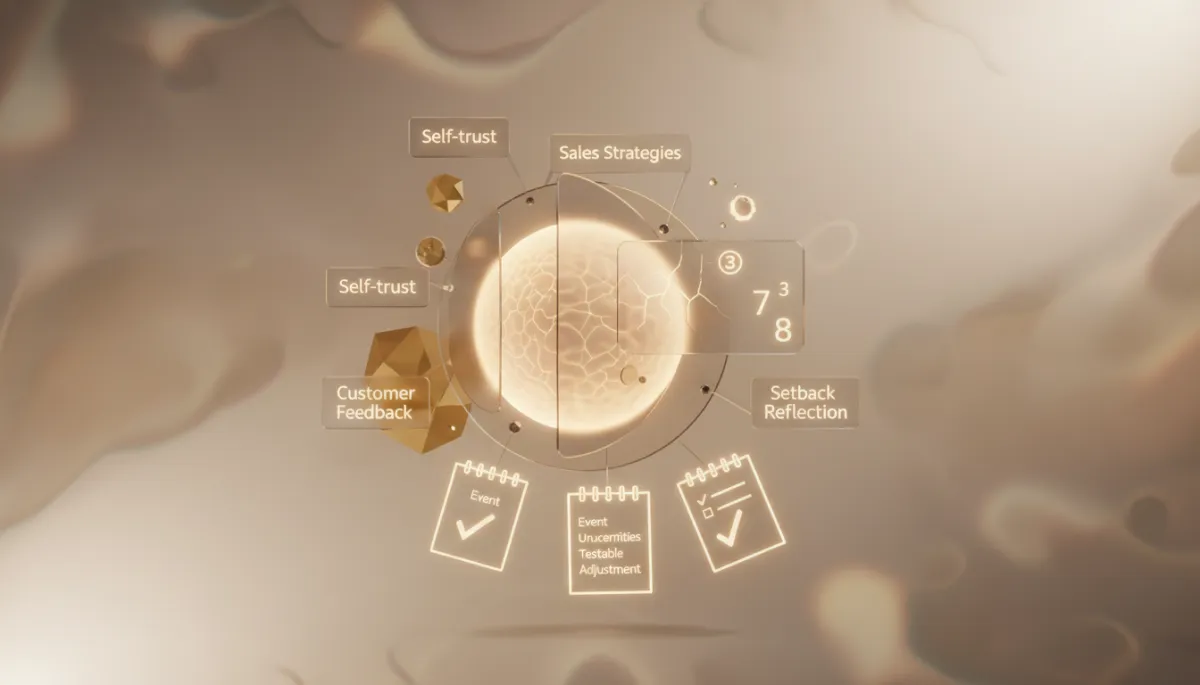
Building Self-Trust in Sales: Strategic Insights
Sales, Self-trust, Leadership Development
Building Self-Trust in Sales: Turning Setbacks into Strategic Insight
For businesses and agencies, sustainable sales performance depends on more than scripts and funnels. It rests on self-trust, disciplined reflection, and the ability to turn every “no” into data that strengthens your next “yes.”
Setbacks as Learning Moments, Not Personal Verdicts
In sales, declined proposals and lost renewals are inevitable. What differentiates resilient teams is not the absence of setbacks, but the way they interpret them. When a prospect chooses a competitor or a long-term client pauses services, leaders face a choice: treat the event as a personal failure, or as a learning moment rich with information.
Self-trust does not mean assuming you were always right. It means trusting that you can look at what happened clearly, extract insight, and adjust your Sales Strategies without collapsing into blame or defensiveness. This orientation is central to the approach described in Eclipsed Intelligence, particularly in chapters 3, 7, and 8, where the author emphasizes using data from real-world setbacks to refine decision making rather than erode confidence.
Factual Reflection Before Storytelling
Our minds are fast storytellers. When a deal falls through, it is easy to jump to narratives: “Our pricing is wrong,” “The market is impossible,” or “I am just not good at enterprise sales.” Chapter 3 of Eclipsed Intelligence warns against this reflex, showing how premature stories can eclipse the actual intelligence available in the situation.
Factual reflection means slowing down long enough to separate what you know from what you are merely assuming. Before explaining the loss to your team, your manager, or yourself, list the observable facts: timeline, stakeholders, questions asked, objections raised, and what was ultimately communicated. Only after this factual layer is clear should you begin forming hypotheses. This sequence protects your self-trust by keeping your conclusions anchored in reality rather than emotion.
📌 Key Takeaway: Facts first, story second. When reflection starts with evidence, your Sales Strategies evolve from grounded insight, not guesswork.
A Practical Reflection Process for a Declined Customer
To operationalize this mindset, give your team a simple, repeatable process every time a meaningful opportunity is lost. Drawing on the decision frameworks in chapter 7 and the feedback loops in chapter 8 of Eclipsed Intelligence, you can use the following three-step structure immediately after a decline:
Capture the event objectively.
Ask respectful follow-up questions for Customer Feedback.
Choose one testable adjustment for future conversations.
Step 1: Make Three Clear Notes
Immediately after a declined proposal, invite your sales professional or account lead to record three concise notes:
The event: What specifically happened? Include date, decision, and key context in neutral language.
Remaining uncertainties: What do you still not know about why the customer decided as they did?
One testable adjustment: What single change will you test in the next similar opportunity?
This simple structure supports healthy Setback Reflection. It acknowledges the loss without dramatizing it, and it directs energy toward learning. Over time, these brief notes create a powerful data set that reveals patterns in Decision Making across your pipeline.

Structured reflection turns individual losses into shared sales intelligence.
Step 2: Ask Respectful Questions About the Decision
When appropriate, follow up with the prospect to request brief Customer Feedback. The tone here is critical: the goal is not to reopen the sale, but to understand their Decision Making process and improve your fit for future clients. Consider language such as:
“Thank you again for considering us. To help us improve, could you share what most influenced your final decision?”
“Were there any parts of our proposal that felt misaligned with your priorities or timing?”
“If you could change one thing about how we approached this, what would it be?”
These questions demonstrate professionalism and respect, reinforcing your brand even in loss. They also surface insights you cannot access from internal speculation alone. As chapter 8 of Eclipsed Intelligence highlights, external perspectives often illuminate blind spots in our own reasoning and restore access to what the author calls “eclipsed intelligence”—insight that was always available, but obscured by assumptions.
Step 3: Choose One Adjustment to Test
With your notes and any feedback gathered, resist the urge to overhaul everything at once. Self-trust in sales grows when teams make deliberate, testable changes and then review their impact. Choose one specific adjustment for your next comparable opportunity. Examples include:
Presenting pricing later in the conversation, after value is fully framed.
Involving an implementation specialist earlier to address practical concerns.
Adding one targeted discovery question about internal approval dynamics.
Track this adjustment over several conversations. Is your close rate shifting? Are objections changing? This disciplined experimentation, advocated in chapter 7 of Eclipsed Intelligence, converts abstract Setback Reflection into measurable improvement and reinforces the belief that your team can influence outcomes through thoughtful action.
Strengthening Self-Trust Across Your Sales Organization
For businesses and agencies, embedding this approach at a team level creates a culture where Self-trust and accountability coexist. Leaders model factual reflection, encourage respectful outreach for Customer Feedback, and review the three notes—event, uncertainties, and testable adjustment—in regular pipeline meetings. Over time, your Sales Strategies become less reactive and more evidence-driven, and your people learn to see each lost deal not as a verdict on their worth, but as a source of Eclipsed Intelligence waiting to be uncovered.
When setbacks are consistently treated as structured learning moments, your organization’s Decision Making matures, your win rates improve, and your teams gain the quiet confidence that comes from knowing they can navigate uncertainty with clarity and integrity—one reflection, one respectful question, and one adjustment at a time.